

Fire Restrictions & Wildfire Safety
Discover the endless possibilities of Lorem Ipsum!

Fire Restrictions & Wildfire Safety in Lake City and Hinsdale County
Lake City and Hinsdale County sit in one of Colorado’s most stunning — and remote — landscapes, and while the risk peaks during hot, dry summers, dangerous fire conditions can develop any time of year. A warm, dry stretch in early spring, a wind event in fall, or an unusually low-snow winter can set the stage for fire just as quickly as August drought.
Nationally, nearly 9 out of 10 wildfires are caused by people. That means the choices we make have a direct impact on the landscapes we experience. The good news: most wildfires are preventable, and the guidelines below are a good place to start.
Before You Arrive
Wildfire conditions in the San Juan Mountains can change rapidly. Taking five minutes to check current conditions before your trip can make the difference between a safe adventure and a dangerous situation.
Check Fire Restrictions
Fire restrictions and burn bans can be in effect county-wide or on specific public lands (National Forests, Wilderness Areas, BLM land).
Check current fire Hinsdale County restrictions here (scroll down a little ways on the home page). Any restriction in place within the county (including National Forests, Wilderness Areas, or BLM land) will be listed here.
You can also find public land restrictions for the specific area(s) you plan on visiting here:
- Gunnison National Forest fire restrictions. Includes portions of the Powderhorn and La Garita Wilderness Areas.
- Rio Grande National Forest fire restrictions. Includes portions of the Weminuche and La Garita Wilderness Areas.
- Bureau of Land Management (BLM) fire restrictions and fire information dashboard
For fire restriction information for the entire State of Colorado, click here.
Check Weather Forecast for Red Flag Warnings
Fire restrictions and bans may also be in place on particularly dry and windy days in Colorado, called Red Flag Warnings. Click here to check the weather forecast to see if any warnings are in effect during your visit.
Understanding Fire Danger Levels and Fire Restriction Stages
When wildfire risk climbs, federal land managers like the U.S. Forest Service use two parallel tools to communicate the threat: a five-step color-coded Fire Danger Level that describes how easily a fire could ignite and spread, and a three-stage Fire Restriction system that limits what visitors are allowed to do on public land. The danger level is informational and helps you decide how careful to be, while restrictions are enforceable rules that change as conditions get worse.
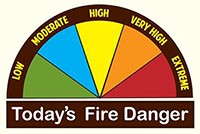 Fire Danger Levels (Low to Extreme):
- Low (Green): Fuels do not ignite readily. Fires that do start spread slowly and are easy to control.
- Moderate (Blue): Fires can start from most accidental causes and spread at a moderate rate. Use normal caution with any heat source.
- High (Yellow): Fine dead fuels ignite easily, and fires can become serious and hard to control if not caught early. Sparks from vehicles, tools, or campfires are a real concern.
- Very High (Orange): Fires start easily from any cause, spread rapidly, and grow in intensity shortly after ignition. Outdoor burning becomes risky even with precautions.
- Extreme (Red): Fires start instantly, spread furiously, and burn with high intensity. Direct attack by firefighters is rarely possible, and any fire is potentially catastrophic.
Fire Restriction Stages (I to III):
- Stage I: The first tier of restrictions, typically prohibiting campfires outside of permanent metal or concrete fire rings in developed recreation sites, and limiting smoking to enclosed vehicles, buildings, or cleared areas at least three feet across. Click here for the full of what is and isn’t allowed during Stage 1.
- Stage II: Tightens the rules further. Generally no open fires of any kind (including charcoal), no smoking outdoors, restrictions on operating chainsaws and other internal-combustion equipment, and limits on welding or using open-flame torches. Driving off designated roads is also commonly banned. Click here for the full list of what is and isn’t allowed during Stage 2.
- Stage III: A full forest closure. The public is not permitted to enter the boundaries of the national forest because conditions are too dangerous. This is the most severe step short of an active evacuation.
Learn more on the US Forest Service website.
Campfire Safety
Campfires are one of the leading causes of wildfires in Colorado. In dry conditions, what looks like an innocent campfire can become a wildfire in minutes.
If Campfires Are Allowed
- Use only designated fire rings — never build a fire on bare ground or near structures
- Keep fires small — a fire you can step over is the right size
- Never leave a fire unattended — not even for a minute
- Keep water, dirt, and a shovel nearby at all times
- Do not burn trash, cardboard, or glass — these create dangerous embers
- Avoid lighting fires during windy conditions or near dry grass, brush, or trees
Extinguishing a Campfire: Do It Right
The rule is simple: drown, stir, feel. Repeat until the ashes are cold to the touch before you leave.
- Drown: Pour water slowly over all embers, coals, and surrounding area
- Stir: Mix ashes and embers with a stick or shovel
- Feel: Use the back of your hand to test — if it’s too hot to touch, it’s too hot to leave
 Fireworks in Lake City and Hinsdale County
Fireworks — including sparklers and consumer-grade fireworks — pose an extreme wildfire risk in dry mountain conditions. A single spark landing in dry grass can ignite a fast-moving fire.
- Always check and follow current local fireworks restrictions and bans before your visit
- Never use fireworks near vegetation, buildings, or vehicles
- Clear dry leaves, pine needles, and debris from around your property before July 4th
- Consider safer alternatives: attend the community celebration, use glow sticks or light displays
- Keep a water source and fire extinguisher nearby if fireworks are permitted
Backcountry & Off-Road Recreation
The Alpine Loop, 4WD roads, and backcountry trails in Hinsdale County put you far from emergency services. Wildfires can spread uphill and with wind extremely fast — sometimes faster than a person can run.
- Avoid parking or resting your vehicle in dry grass — hot exhaust can ignite vegetation
- Secure chains and metal equipment that could create sparks on rocky terrain
- Use camp stoves only on bare ground — never in dry grass or near brush
- Share your trip plan and expected return time before heading into the backcountry
- Do not rely on rescue — plan to self-evacuate while routes are still open
If You See Smoke or Fire
In Hinsdale County, help can be far away. Early action is the safest action.
- Call 911 immediately
- Leave the area early
- Do not wait for an official evacuation order if you feel unsafe
- Move away from the fire — crosswind if possible, never uphill into the fire’s path
Stay Informed: Sign Up for Alerts
Register for Hinsdale County’s emergency alert system at hinsdale.genasys.com/portal/en. This free service will notify you of fire, evacuation, and other emergencies in the county. Cell service in Hinsdale County can be limited in remote areas — sign up before you leave home.
Do Lake City Right
Lake City’s natural beauty — the San Juan peaks, the dark skies, the quiet valleys — is what draws people here. It’s also what makes fire prevention so critical. The lands surrounding Lake City are 96% public land. One spark can change this landscape forever. Please recreate responsibly and help us protect the places that make Lake City special.
Quick Reference
Emergency: Call 911
Hinsdale County Alerts: hinsdale.genasys.com/portal/en
Fire Restrictions: fs.usda.gov/gmug (Gunnison Ranger District)
Red Flag Warnings: weather.gov
More info: lakecity.com